|
 |
|
STC Program First-Grade Units
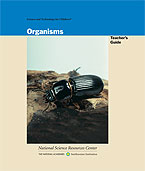 Organisms Organisms
Organisms provides hands-on experiences that help students develop an understanding of and sensitivity to living things. Students create and maintain a woodland habitat containing pine seedlings, moss, pill bugs, and Bess beetles or millipedes. They also set up and observe a freshwater habitat into which they introduce Elodea and Cabomba plants, pond snails, and guppies. With both plants and animals in each habitat, students have the opportunity to observe how these organisms coexist. Through studying the needs and characteristics of a variety of organisms, the students are able to draw conclusions about how plants and animals are similar and different. In a final lesson, students apply what they have learned about organisms to humans by exploring how humans are similar to and different from other living things.
Back to units page
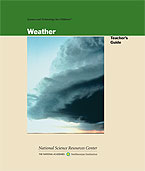 Weather Weather
Weather introduces students to the concept of weather and how it affects their lives. Using a variety of tools, students observe, discuss, measure, and record data on cloud cover, precipitation, wind, and temperature. They learn how to read a thermometer and construct a rain gauge to measure precipitation. They also study cloud formations and use a wind scale to estimate the speed of wind. To apply their new skills and knowledge, students compare their own weather predictions with an actual weather forecast and use the weather data they have collected to form generalizations about the weather in their own locale.
Back to units page
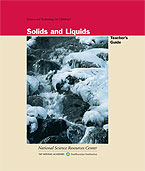 Solids and Liquids Solids and Liquids
In Solids and Liquids, students investigate the similarities and differences in a variety of common solids and liquids. First, they observe, describe, and compare a collection of solid objects, focusing on such properties as color, shape, texture, and hardness. They also perform tests to determine whether the objects roll or stack and float or sink, as well as whether they are attracted to a magnet. Investigations of liquids center on how various liquids look and feel, their fluidity, how they mix with water, and their degree of absorption. In a final lesson, students compare the properties of solids and liquids and identify how they are similar and different.
Back to units page
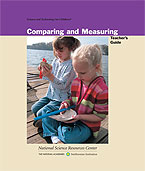 Comparing and Measuring Comparing and Measuring
In Comparing and Measuring, students explore the concepts that underlie the science skills of comparing and measuring. The lessons are based on a developmental sequence that includes three activities: comparing, matching, and measuring. Initially, students compare lengths by matching measuring tape to their own heights and the lengths of their arms and legs. They make the transition from matching to measuring length by quantifying nonstandard units of measure (in this case, their own feet) and discover that using nonstandard units of measure produces varied results. Finally, students use standard units of measure, such as Unifix Cubes™ and measuring strips, to measure height, width, and distance. Through these activities, students begin to understand key measuring concepts, such as using beginning and ending points, a common starting line, and standard units of measure.
Back to units page
|
|