|
 |
|
STC Program Third-grade Units
The NSRC has developed a series of science reading resources for the STC units on this page. These STC BOOKS™ provide complementary reading selections to enhance student interest and content retention. BOOKS may be purchased individually, in sets of eight, or by science strand. Look for links to individual titles below or go to our STC BOOKS™ overview page.
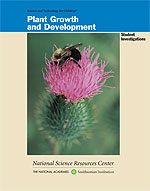
Plant Growth and Development
In Plant Growth and Development,, students have the opportunity to observe each stage in the life cycle of a simple plant. Working with Wisconsin Fast Plants™ (Brassica rapa), which germinate, mature, and go to seed within a 40-day period, students plant seeds and watch the seedlings emerge. Later, they thin and transplant seedlings. As they watch their plants grow, students learn that plants need nutrients from the soil, as well as water and light, to thrive. As the unit expands to focus on the interdependence of living things, students cross-pollinate the flowers with dried honeybees. Finally, they harvest mature seeds and determine seed yields. These experiences deepen students’ understanding of the characteristics of living organisms and their relationship with and dependence on their environment.
Goals
Unit Overview
STC Meets the Standards
Sample Lesson
To Order
Science Reading Resource
Back to units page
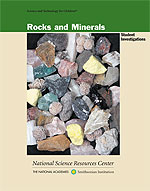 Rocks and Minerals Rocks and Minerals
Rocks and Minerals, students explore the differences and similarities between rocks and minerals by investigating samples of these earth materials, performing a series of tests similar to geologists’ field tests, and reading about rocks and minerals and how they are used. The first lessons focus on rocks. The students then turn their attention to a set of 12 minerals and test them to identify properties such as streak color, luster, transparency, hardness, shape, and magnetism. After completing these observations, students compile them into their own Minerals Field Guide. In a culminating activity, they are challenged to apply their knowledge and skills to identify new minerals. They then report on how rocks and minerals are used.
Goals
Unit Overview
STC Meets the Standards
Sample Lesson
To Order
Science Reading Resource
Back to units page
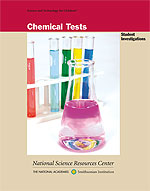 Chemical Tests Chemical Tests
Chemical Tests introduces students to the science of chemistry by challenging them to explore and determine the identity of five common household chemicals: sugar, alum, baking soda, and cornstarch. Students begin by focusing on the physical properties of color, form, and texture. Next, they explore chemical properties by observing how the five powders interact with water, vinegar, iodine, and red cabbage juice. These tests enable them to explore phenomena such as crystallization and to observe the processes of evaporation and filtration. Finally, students apply their skills and their knowledge of the five chemicals to identify a variety of “mystery” mixtures. As a result of conducting these investigations, students develop scientific skills such as observing and recording results, forming conclusions on the basis of experience, communicating results, and applying their knowledge to solve problems.
Goals
Unit Overview
STC Meets the Standards
Sample Lesson
To Order
Science Reading Resource
Back to units page
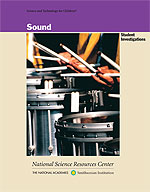 Sound Sound
In Sound, students use tuning forks, slide whistles, strings, and other sound-producing objects to investigate the characteristics of sound. Students learn that sound is caused by vibrations, and they explore how sound travels. They learn about the relationship of pitch and volume to the frequency and amplitude of vibrations. They discover, for example, that they can alter pitch by varying the length or tension of a string. Constructing simple stringed instruments, they discover how they can increase the volume of the sound produced by the strings. Students investigate the characteristics of another common sound-producing mechanism—the human vocal cords—and build model vocal cords. They also learn about the anatomy and functioning of the human ear. They apply what they learn in the unit by designing and building musical instruments or other sound-producing devices.
Goals
Unit Overview
STC Meets the Standards
[Sample Lesson]
To Order
Science Reading Resource
Back to units page
|
|