|
 |
|
STC Program Forth-grade Units
The NSRC has developed a series of science reading resources for the STC units on this page. These STC BOOKS™ provide complementary reading selections to enhance student interest and content retention. BOOKS may be purchased individually, in sets of eight, or by science strand. Look for links to individual titles below or go to our STC BOOKS™ overview page.
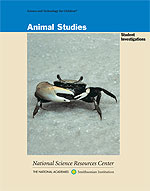 Animal Studies Animal Studies
In Animal Studies, students care for and observe three animals from different habitats—the dwarf African frog, the fiddler crab, and the land snail. Students learn about what animals need to survive, the primary parts of their anatomical structure, and the ways in which they are suited for life in a particular environment. Students create and maintain individual logs in which they record their observations of each animal over time. These observations focus on animal behavior, including methods for food getting, movement, and protection. Toward the end of the unit, students apply what they have learned about structure, habitat, survival needs, and behavior to study a fourth classroom animal: the human. They also conduct an animal research project and decide how they will present their findings to the class.
Goals
Unit Overview
STC Meets the Standards
Sample Lesson
To Order
Science Reading Resource]
Back to units page
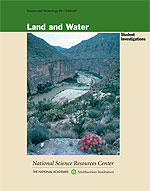 Land and Water Land and Water
In Land and Water, students investigate the interactions between land and water. Using a stream table as their model, students observe how runoff causes stream formation; how ground water forms; how soil is eroded, transported, and deposited; and how water shapes land. Students create hills, build dams, and grow vegetation. Miniature valleys, waterfalls, and canyons form in the stream tables as water flows over the soil. Students begin to appreciate the vastness of stream systems by creating aerial diagrams of their stream table results. The stream table also serves as a basis for investigations of the water cycle. Through observing the model, manipulating certain parts of it, and testing interactions under various conditions, students discover how water changes the shape of land and how land formations, in turn, affect the flow of water. They apply the concepts they have learned to photographs of land and water on earth.
Goals
Unit Overview
STC Meets the Standards
Sample Lesson
To Order
Science Reading Resource
Back to units page
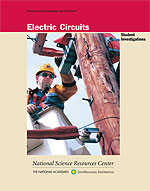 Electric Circuits Electric Circuits
In Electric Circuits, students are first introduced to the basic properties of electricity as they learn about electric circuits and the parts of a light bulb. Next, students learn about conductors and insulators and about the symbols used to represent the parts of a circuit in circuit diagrams. Students also explore different kinds of circuits, learn about switches, construct a flashlight, and investigate the properties of diodes. Finally, students apply their knowledge and skills to wire a cardboard house.
Goals
Unit Overview
STC Meets the Standards
Sample Lesson
To Order
Science Reading Resource
Back to units page
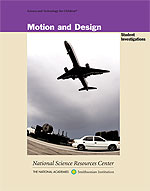 Motion and Design Motion and Design
In Motion and Design, students explore the physics of motion and apply these concepts to technological design. Using plastic construction materials, weights, rubber bands, and propellers, students design and build vehicles. Students record their designs using technical two-view and three-view drawings. They test how fast the vehicles move and use their findings to redesign the vehicles to move more efficiently. Cost analysis is one of the students’ design requirements. As students design their vehicles, they intuitively apply concepts such as friction and kinetic and potential energy. They also explore the effect of gravity on motion. The unit concludes by challenging students to solve a design challenge and to present their findings to the class.
Goals
Unit Overview
STC Meets the Standards
Sample Lesson
To Order
Science Reading Resource
Back to units page
|
|