|
 |
|
STC Program Fifth-grade Units
The NSRC has developed a series of science reading resources for the STC units on this page. These STC BOOKS™ provide complementary reading selections to enhance student interest and content retention. BOOKS may be purchased individually, in sets of eight, or by science strand. Look for links to individual titles below or go to our STC BOOKS™ overview page.
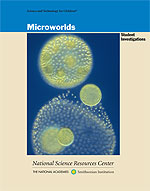 Microworlds Microworlds
In Microworlds, students examine everyday objects as well as microorganisms with a variety of magnifying devices. They begin by investigating several common objects with the unaided eye. Using a variety of lenses, including hand lenses, acrylic spheres, and water drops, they learn that a magnifying lens must be transparent and curved. Next, students use a microscope to view inanimate objects. They learn proper focusing and lighting techniques as well as how to prepare slides. Students prepare a section of onion skin and observe its cells. Students’ attention then turns to living specimens. Using a microscope, they view three microorganisms—Volvox, Blepharisma, and the vinegar eel. They study the cell structure of these organisms and observe how the organisms feed, grow, and multiply. In a final challenge, students use the microscope to examine cultures they have grown from hay and grass infusions.
Goals
Unit Overview
STC Meets the Standards
[Sample Lesson]
To Order
Science Reading Resource
Back to units page
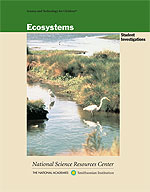 Ecosystems Ecosystems
Students begin Ecosystems by setting up a terrarium in which they grow grass, mustard, and alfalfa plants. Then they add crickets and isopods. They also set up an aquarium into which they introduce snails, guppies, elodea, algae, and duckweed. By connecting the terrarium and aquarium, students are able to observe the relationship between the two environments and the organisms living within them. Using test ecocolumns that contain only plants, students simulate the effects of pollutants—such as road salt, fertilizer, and acid rain—on an environment. Students then use a food-chain wheel to make inferences about the effects these pollutants might have on their own miniature ecosystems. Later, students read about, explore, and discuss the Chesapeake Bay as a model ecosystem. They analyze this ecosystem from the viewpoint of various users–waterman, dairy farmer, land developer, recreational boater, and resident—and present their findings to the class. The activity enables students to appreciate the trade-offs that must be made to reach mutually acceptable solutions to environmental problems.
Goals
Unit Overview
[STC Meets the Standards
Sample Lesson
To Order
Science Reading Resource
Back to units page
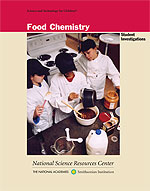
Food Chemistry
In Food Chemistry, students explore basic concepts related to food and nutrition. They set up their own classroom laboratory and perform physical and chemical tests to identify the presence of starch, glucose, fats, and proteins in common foods. Some of the tests are relatively simple and produce “yes-or-no” results; others require multiple steps. Still other tests, such as the glucose test, produce results that require interpretation. Through readings, students discover how proteins, fats, and carbohydrates, as well as vitamins, are related to good health. They also learn how to interpret food labels. In a final challenge, students apply their knowledge and skills to analyze the nutritional components of a marshmallow.
Goals
Unit Overview
STC Meets the Standards
[Sample Lesson]
To Order
Science Reading Resource
Back to units page
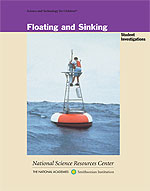 Floating and Sinking Floating and Sinking
In Floating and Sinking, students investigate the phenomenon of buoyancy. They begin by making a spring scale with which they weigh various objects. They make clay boats, test the boats’ buoyancy, and discover that altering the shape of the boats affects buoyancy. Students are then challenged to design a boat that has a certain loading capacity. These experiments allow them to witness several surprising phenomena; for example, some “floaters” are heavier than some “sinkers,” and large objects are not always heavier than smaller objects. Students then turn their attention to differences between objects placed in fresh water and in salt water. They construct a hydrometer that compares the levels at which objects float in both types of water.
Goals
Unit Overview
STC Meets the Standards
Sample Lesson
To Order
Science Reading Resource
Back to units and modules page
|
|