

| ||
  |
| |
|
|
 |
 |
|
STC Program sixth-grade Units The NSRC has developed a series of science reading resources for the STC units on this page. These STC BOOKS™ provide complementary reading selections to enhance student interest and content retention. BOOKS may be purchased individually, in sets of eight, or by science strand. Look for links to individual titles below or go to our STC BOOKS™ overview page 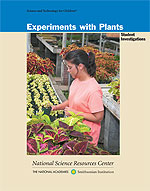 Experiments with Plants Experiments with Plants In Experiments with Plants, students apply the knowledge and skills they have gained in earlier STC life science units to investigate some of the variables that affect plant growth and development. The main objective of the unit is to enable students to design and conduct a controlled experiment. They begin by studying the key variables that affect the life, health, and reproduction of the Wisconsin Fast Plant™ and how they can manipulate these variables. Working in teams, students formulate a question about the plant and carry out a controlled experiment designed to answer that question. During the ensuing weeks, they observe the plants and record their data. Each team then shares its results with the class. Final activities entail germinating seeds that students have gathered from the plants and exploring tropisms. Goals
Goals
Goals 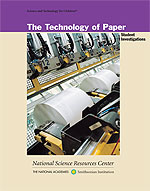 The Technology of Paper The Technology of PaperIn The Technology of Paper, students explore the properties of paper, make paper by hand, and discover how the properties of paper relate to how it is used. By testing six types of paper for smoothness, tear-resistance, opacity, water-resistance, and ink receptivity, students deepen their understanding of the relationship between the properties of a certain type of paper and its intended uses. Students read about industrial papermaking and explore hand papermaking. Using the class hand-papermaking process, students investigate the role of additives and of embedding and embossing in the production of paper with a variety of properties. In a final activity, students apply their learning and experience to work through a four-step technological design process as they create their own recycled paper product. Goals
|
|
|
||||||
|
|
| ©2026 NATIONAL SCIENCE RESOURCES CENTER | |
|
|






 Measuring Time
 Magnets and Motors