|
 |
|

NSRC Theory of Action
The NSRC’s Theory of Action, depicted below, advocates that the foundation of all reform is knowledge of research and best practices and a solid infrastructure for reforming science education programs. The design of the theory and the associated work to implement it should reflect research in the following areas:
- Development of science concepts
- Learning and teaching
- Assessment of learning
- Evaluation of programs
- Systems thinking
- Accountability structures
- Introduction of interventions and the process of change
- Scaling-up principles
- Incentives Methods for ensuring sustainability
|
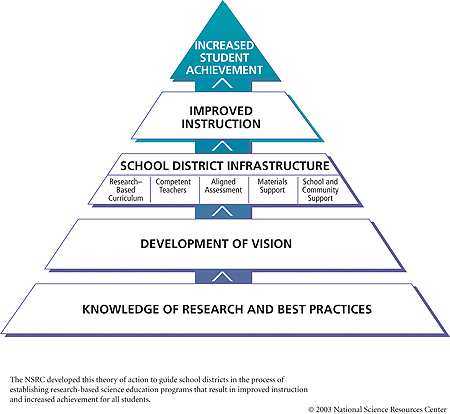 |
back to top
NSRC Science Education Systemic Reform Model
One critical aspect of the NSRC Theory of Action is the establishment of an infrastructure needed to support learning. To establish an effective infrastructure, leaders need to have a shared vision of effective science learning and teaching and implement five essential components simultaneously. The NSRC has defined this system as the NSRC Science Education Systemic Reform Model, which is illustrated below.
Components of the system include:
- A curriculum framework and comprehensive research-based K–16 science instructional program based upon research findings.
- Teachers participating in professional development programs that are aligned with current research about adult learning and designed to move teachers from novice to expertise.
- Assessments that are aligned with research about how students learn and that elicit meaningful feedback about student learning.
- Cost-effective and efficient systems that supply resources and materials to teachers.
- Administrative and community leaders providing long-term support for research-based science learning and teaching.
back to top
NSRC Stages of Reform
Systemic reform requires leaders with technical knowledge of the five essential components of science education reform, as well as access to products and services that can be used to move leaders through the various stages of reform. During the past two decades, the NSRC has developed differentiated products and services to assist districts, regions, states, and countries in moving through these stages.
The work for each stages of reform becomes increasingly more complex, requiring more time, resources, and technical expertise. A general outline of the Stages of Reform and related work is provided below.
Stages
|
Goals
|
General Description of Work
|
Assessing Strengths, Opportunities, and Challenges
|
Assess the landscape to understand the context of work.
|
Analyze the strengths, weaknesses, opportunities, and threats (SWOT). Monitor and document needs, challenges, and development of assets annually.
|
Building Awareness for Reform
|
Develop a shared vision of the importance of an effective science and technology education needed to prepare informed citizens and a scientifically literate workforce.
|
Plan and conduct annual awareness events for school, university, and business and other community leaders, including parents. The events are designed to develop a vision of effective science learning and teaching and the system that is needed to support this vision.
|
Initiating Reform
|
Provide leaders with the expertise and support needed to develop a five-year strategic plan for establishing a comprehensive and challenging K–12 science program. The plan will benchmark with exemplary U.S. districts that have significantly improved student achievement, attitudes, and skills in science.
|
Annually identify and recruit leadership teams to attend the NSRC Leadership Development and Science Education Strategic Planning Institutes. The institutes will prepare the teams to take leadership in establishing systemic reform programs based on research and promising practices.
|
Implementing Reform
Beginning
Middle
Advanced
|
Provide a system of technical assistance to schools and districts in partnership with government, industry, the education community, and parents. This ongoing assistance will help school districts to establish, sustain, and continuously improve the infrastructure needed to support high-quality instruction for all students for a decade and longer.
|
Develop and implement academies and other events and services needed to provide technical assistance to implement research-based programs:
- Pilot testing and development of curriculum frameworks;
- Differentiated professional development programs for moving teachers from being novice to developing competency;
- Strategies for assessing student learning in science;
- Cost effective and efficient materials support systems to supply teachers with equipment and supplies needed to teach science;
- Strategies for integrating mathematics, reading, and writing within the context of learning and teaching science;
- Programs for educating administrators and community leaders to establish, continuously improve, and sustain effective science programs
- Ongoing technical assistance services that regions and states need to provide districts to help them sustain their efforts.
|
Building Leadership Capacity
|
Develop a corps of informed leaders representing the scientific and education communities who have knowledge and expertise.
|
Design annual program activities that will systematically cultivate a corps of 100 or more teachers, school administrators, scientists, and other community officials to conduct institutes, academies, and workshops.
|
Evaluation
|
Establish and monitor performance measures.
Report progress and impact data.
|
Develop a formative and summative evaluation program to assess the quality of program activities, progress being made in accomplishing goals, and assessing impact on student achievement.
|
Dissemination
|
Provide stakeholders with information about the program and its impact.
|
Disseminate information to leadership groups and interested stakeholders.
|
Implementing and Sustaining Exemplary Science Programs
The NSRC supports school districts that initiate science education reform by disseminating research-based science instructional materials, nurturing science education leadership development, and advancing the professional growth of teachers.
back to top
|
|